Predicted Leads: Forecast Your B2B Campaign Before You Launch
Predicted Leads forecasts how many interested leads a campaign should generate before you launch, so you can tune targeting and messaging while you build it, not after.


Key takeaways
- Predicted Leads forecasts how many interested leads a campaign should produce before you launch, so you plan with data instead of crossing your fingers.
- The estimate updates live at each step of the Campaign Wizard, showing how your messaging, targeting and contact quality each move the number.
- It blends published B2B benchmarks with patterns from thousands of real AvairAI campaigns, and typically lands within about 15 to 20% of the actual result.
- A flat or falling forecast is a diagnostic. It points to a specific weak spot in your messaging, targeting or contacts before you spend a send finding out the hard way.
- Tighter, more relevant campaigns score higher than broad ones. Precision beats spray-and-pray, and the number shows it.
Stop launching campaigns on a hope
You have spent the afternoon building a campaign. The messaging is written, the account list is built, the contacts are loaded. Your cursor hovers over Launch, and the only honest answer to "will this actually work?" is a shrug.
That shrug is expensive. Run the campaign and you might see a 2% reply rate, or you might burn three weeks of effort for almost nothing, and you will not know which until it is over. Guessing is a bad bet, because most of a B2B purchase now happens before a buyer ever speaks to a vendor. Gartner expects 80% of B2B sales interactions to run through digital channels, and finds that buyers spend only about 17% of their journey meeting with any potential suppliers. The campaigns that land are the ones aimed at the right accounts with a relevant message, not the ones sent in the highest volume.
Predicted Leads takes the shrug out of that moment. It is a forecast you can read and act on while you build, not a post-mortem you read three weeks later.
What Predicted Leads is
Predicted Leads is AvairAI's forecasting model. As you build a campaign, it estimates how many interested leads that campaign should generate, based on published industry benchmarks and the performance of real campaigns. An interested lead is a Marketing Qualified Lead (MQL), a contact who replies or engages with genuine interest. AvairAI surfaces those leads; your reps book and close. The point is to show you the likely outcome of each decision while you can still change it, instead of leaving you blind until the campaign is live.
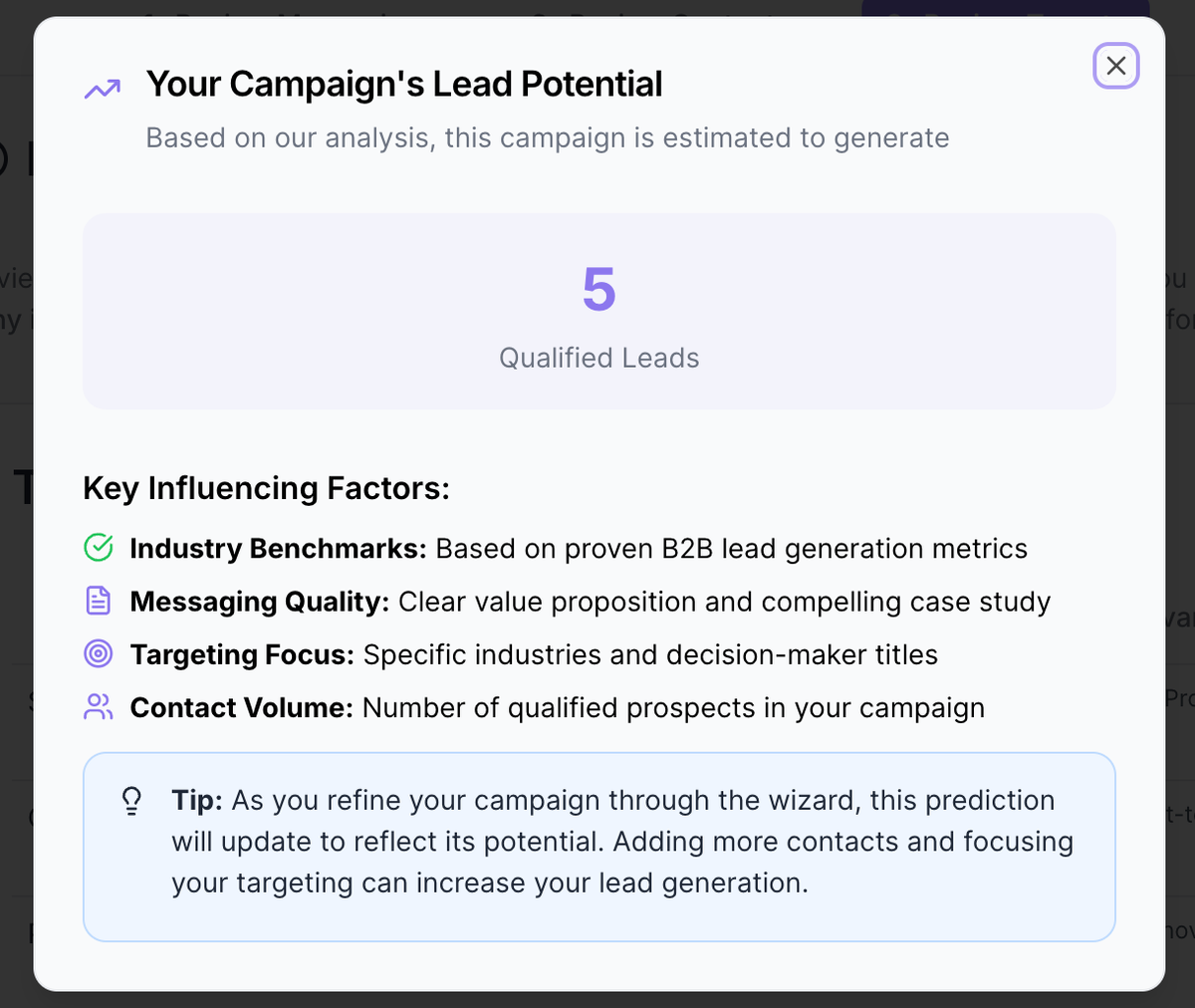
The forecast sits in the top-right corner of the Campaign Wizard and recalculates as you work, from the first read of your messaging through to the final contact list. Every move you make nudges it up or down, and that movement is the useful part.
What the forecast is built on
Two data sources feed the model, and the second is the one most tools cannot match.
The first is the ordinary benchmark layer: open and reply rates by industry and company size, phone connection rates, deliverability and bounce patterns by domain, plus the seasonal swings in how much prospects engage. Useful, but public and generic.
The second is AvairAI's own campaign history, the actual results of thousands of campaigns run on the platform. That is where the real signal lives: which industries convert, which personas reply, which messaging angles land and what contact mix produces the most responses. Put the two together and the forecast typically lands within about 15 to 20% of the actual result. It leans conservative by design, which matters when you are making real decisions on it.
How the forecast moves as you build
Step 1, review messaging. The wizard opens with a deliberately conservative baseline, often somewhere around 0.75 to 1.0% of contacts converting. It is drawn from your industry's typical patterns and the value proposition AvairAI reads straight from your website. That is the only input it needs. Point it at your site and it finds, or writes, the case-study insight for you, so there is nothing to upload.
Step 2, generate content. Once AvairAI writes and personalizes every message, the estimate usually climbs toward 1.1%. Personalization is not decoration. McKinsey found that faster-growing companies drive 40% more of their revenue from it than their slower-growing peers, and the model rewards messaging that is specific about the pain you solve and who you solve it for. If you want the mechanics, here is our guide to personalized prospecting at scale.
Step 3, target accounts. When you refine the account list, the forecast often reaches 1.2%. This is where precision pays. Tight, relevant targeting, the kind you get from tiering your target accounts and reaching them on a real Trigger Signal, lifts the number; a broad "everyone in the industry" list drags it down. The forecast is quietly making the case that spray-and-pray stopped working.
Step 4, generate contacts. The final estimate, typically around 1.3%, factors in the contacts AvairAI verifies: how many decision-makers you reached, how relevant their roles are and how clean the data is. Clean data is not a nicety. Gartner puts the average cost of poor data quality at $12.9 million a year per organization, and on a campaign it shows up as bounced sends and a damaged sender reputation. Contact Verification cuts bounce from about 30% to under 2%, which is part of why a tighter list holds its forecast.
Reading a stuck forecast
The number itself is not the prize. What it tells you when it stops moving is.
Watch the progression. If the forecast is flat from step 1 to step 2, your messaging probably lacks a sharp, differentiated point of view. If it drops at step 3, your targeting is likely too broad or poorly matched to what you sell. If it slips at step 4, the contact quality or volume is not pulling its weight.
Here is what that looks like in practice. Say you sell a compliance tool to SaaS companies. You start wide, every SaaS company between 50 and 500 employees, and the forecast stalls at step 3. The model is telling you the list is too broad to feel relevant to anyone on it. So you narrow to Series B fintech that recently raised a round or hired a compliance lead, a genuine signal that they are feeling the pain right now. The list shrinks from a few thousand contacts to a couple hundred, and the forecast climbs. Fewer contacts, more expected leads, because relevance, not volume, is what earns a reply. That is the case for quality over quantity made visible, one number at a time.
Why a forecast beats flying blind
Most platforms let you configure a campaign, launch it and hope, then tell you weeks later whether it worked. Predicted Leads shows you the likely outcome up front, while every input is still editable.
That changes how the tool feels to use. Instead of executing in the dark, you learn what makes a campaign work as you build it: which messaging earns a lift, which targeting earns a drop. It nudges you toward fewer, sharper campaigns rather than set-and-forget blasts, and it gives you the confidence to commit real budget to the accounts worth it. None of that needs a data analyst. It needs you to read one number as it moves.
Build better campaigns, not just bigger ones
A few habits get the most out of the forecast.
Start with a website that earns it. The clearer your site is about the outcomes you deliver and who you deliver them for, the better the value proposition AvairAI extracts and the stronger your baseline.
Resist the urge to target everyone. The forecast consistently rewards two or three closely related segments over a wide net, so pick the accounts that look like the customers you already win with and reach them on a Trigger Signal.
Treat early, low numbers as a starting line, not a verdict. They are built to rise as you add personalization, tighten targeting and verify contacts. Notice which change moves the number most, then carry that lesson into your next campaign.
The honest part: it is an estimate
Predicted Leads is a conservative forecast, not a promise. Because the model is tuned to under-promise, plenty of customers see results come in above the number, and occasionally below it. Treat it as a well-informed planning tool, the difference between walking into a launch with a reasoned expectation and walking in blind.
That is also how AvairAI works overall. The platform builds and runs the whole campaign, the targeting, the messaging, the verified contacts and the multi-channel cadence, then hands your reps ready-to-run tasks so they can do what only people can: have the conversations that close. This is Pair Selling. The forecast just lets you see where you are headed before you take the first step.
Point AvairAI at your website and watch the number build as you do. On annual plans the result is backed by a lead guarantee, because we only win when you win. Start a 14-day free trial, no credit card required, and plan your next campaign with data instead of a shrug.
← Back to all articles