AvairAI Contact Verification: Catch Dead Contacts Before You Launch
Dead contacts wreck your bounce rate and your sender reputation. Here is how AvairAI verifies email and employment at the moment of launch to keep every send clean.


Key takeaways
- B2B contact data goes stale fast. Marketing databases lose roughly 22.5% of their accuracy a year as people change jobs and companies move or merge.
- Bad data is expensive. Gartner puts the average cost of poor data quality at $12.9 million a year per organization, and wasted outreach is part of that bill.
- Once your bounce rate climbs past 2%, mailbox providers start doubting your domain, and even your good emails slide into spam.
- AvairAI runs Contact Verification at the moment of launch, not when you import a list. It checks email deliverability and whether the person still works there, then sorts every contact green, yellow or red.
The real cost of emailing people who already left
Picture a campaign you actually care about. Your team spent two weeks on the messaging, the value proposition is sharp, the account list is tight, and you have 500 contacts you would genuinely like to talk to. Launch day comes, the emails go out, and a third of them bounce because those people no longer exist at those companies.
That sting is the obvious part. The expensive part is what the bounces do to everything you send next.
Mailbox providers read a high bounce rate as a sign you are working from a stale or purchased list. Push past about 2% and your domain reputation takes the hit, and from there it compounds: your clean emails start landing in spam, open rates drop, replies dry up, cost per lead climbs and the sales cycle stretches out. One bad list quietly taxes every campaign that follows it. That is the real damage a rising bounce rate does to your sender reputation, long after the bounce notices stop arriving.
There is a human cost too. Your reps did everything right and still got silence, not because the pitch was wrong but because half the inboxes were empty. That wears people down faster than rejection does. When we tightened up our own verification, our bounce rate fell from about 30% to under 2%. The bigger change was not the saved sends. It was that the team trusted the list again.
Why B2B contact data goes bad faster than you think
Here is the uncomfortable truth underneath every outbound program: the data was decaying before you bought it. People change jobs, teams reorganize, companies get acquired and email formats change. HubSpot's database-decay research puts the drift at about 2.1% a month, roughly 22.5% a year. On a 10,000-record list, that is more than 2,000 contacts gone wrong inside twelve months, which is faster than most teams ever stop to check. It is also why your contact data is usually worse than you think.
The cost shows up in places finance notices. Gartner estimates that poor data quality costs the average organization $12.9 million a year, and at the macro level IBM pegged the drag of bad data on the US economy at $3.1 trillion a year. For a sales team, a slice of that is simply the hours spent researching dead contacts plus the deliverability damage from emailing them.
Buying your way out is its own trap. The major contact-data providers charge a premium per record, and that record can already be months old by the time it reaches your CRM. Building your own checks is no easier. You end up paying for several data sources, an email validator and an employment lookup, then someone has to run them, reconcile the conflicts and merge the results. It turns into a part-time job just to know who you are about to email. And whenever you run those checks, a week or a month before launch, the data starts decaying again before you hit send.
Verification at the moment that matters
So the useful question is not "is this data clean," it is "is it clean right now, the second before I reach out." That is the window AvairAI verifies in.
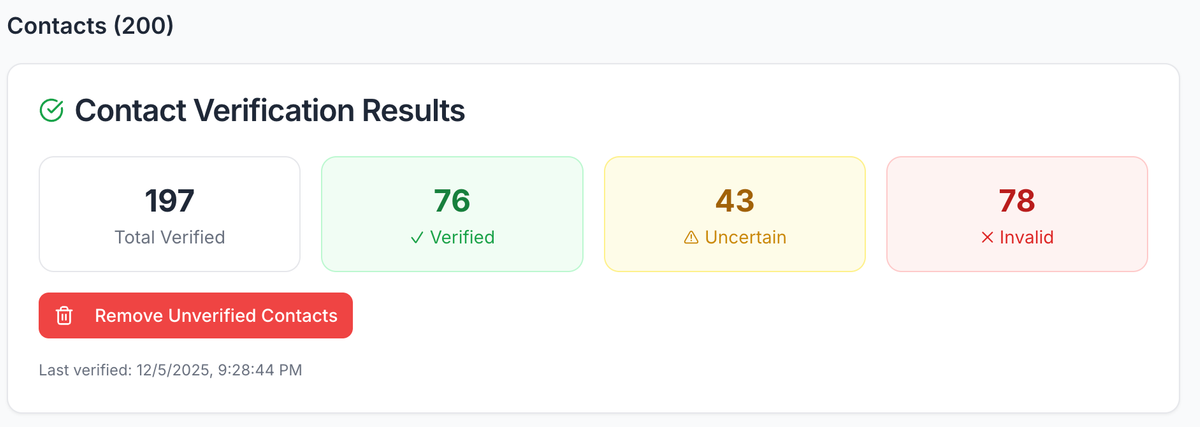
Contact Verification is not a syntax check that confirms the @ sign is in the right place. It runs at campaign launch and looks at several dimensions of contact quality at once. It confirms the email is deliverable. It cross-references multiple sources and our database of 105M+ verified contacts to confirm the person still works where your list says they do, the check most basic validators never run, and one reason employment verification beats a plain email check. It flags role-based addresses like info@ or sales@ that rarely reach a human, spots disposable inboxes, catches catch-all domains that accept everything and deliver nothing, and screens for spam traps. That email-plus-employment combination is what makes it a real layered approach to verification rather than a one-pass scrub.
You do not have to bring a list at all. As part of building a campaign, AvairAI sources contacts that match your ideal customer profile (ICP), 250 per campaign and up to 500 once you add your own. Whatever the source, every contact runs through the same check before anything sends.
The output is deliberately plain: a traffic light. Green contacts are good to send. Yellow ones deserve a quick look. Red ones come off the list. Each contact carries the detail behind its rating, so you can see why it landed where it did and decide what to do with it.
What happens when you click verify
The first pass is the mechanical stuff, and it is fast. Is the address well formed, does the domain resolve, are there MX records so the domain can even receive mail. Then AvairAI checks with the receiving server to see whether it will accept mail for that specific address. Most validators stop here.
The part that matters more is employment. A valid mailbox means little if the person left six months ago. Their replacement may have no interest in what you sell, or the address may quietly forward into another department. AvairAI cross-references its sources to confirm the person is still in the seat, and it weighs the patterns rather than matching against one static table.
For 100 contacts the whole thing takes about 15 minutes, and it runs in the background while you keep building the campaign, with results filling in as each contact clears.
One VP of Sales at a data-security SaaS company, an early heavy user, put it this way: "AvairAI's new Verify Contacts feature is fantastic. It tells me exactly which contacts are good that are green, which contacts are yellow and so need a review and which ones are red so should be removed. It gives me so much confidence as I start executing a new campaign."
What this looks like on a real campaign
Take that 500-contact product launch. Without a check, you might lose 75 addresses to bounces in the first hour, ding your domain reputation and watch the rest of a carefully built campaign drift toward spam. Verify first and you find those 75 before a single send, drop or replace them, and launch clean, with bounce holding under 2% and your reputation intact for the next campaign.
Or take the stale-CRM case: 1,000 contacts nobody has touched in six months. Run verification and the list sorts itself. Say 180 come back red and leave, 150 land yellow for review and 670 are green and ready. Your reps spend the week on the 670 real people instead of guessing their way across all 1,000.
Note: the red, yellow and green ratings each include detailed findings for the contact, so you can decide what to do with the borderline cases.
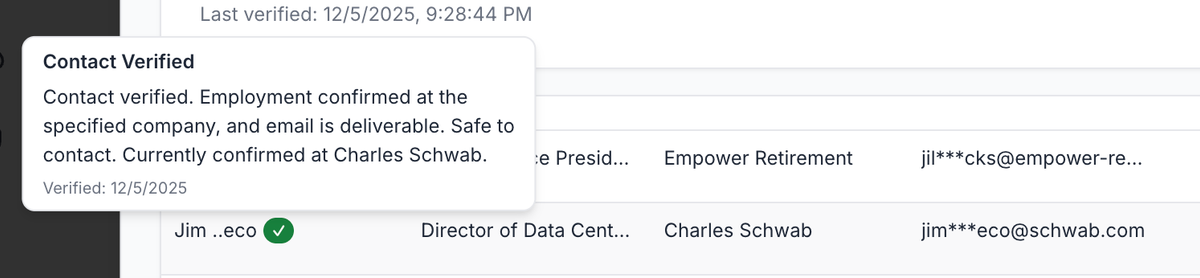
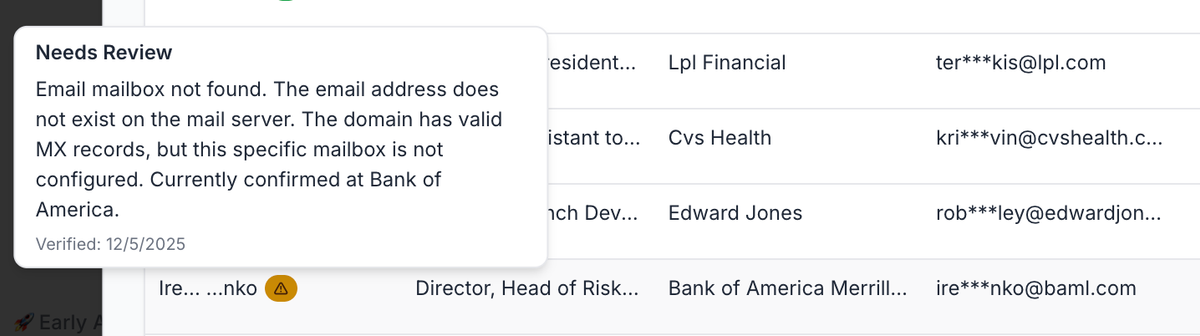
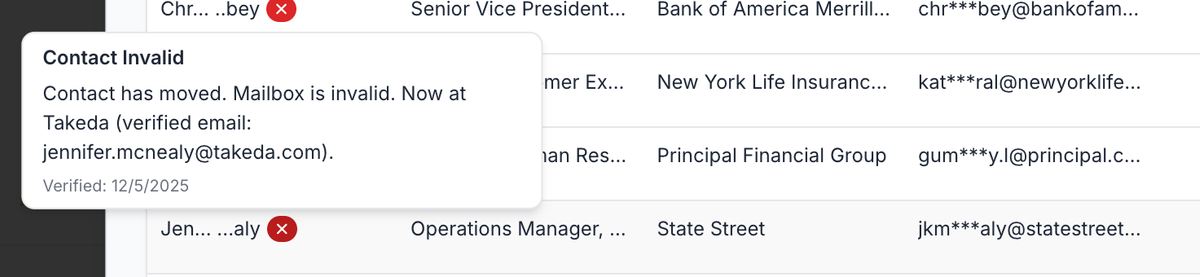
We have watched this play out in our own campaigns. Bounce fell from about 30% to under 2%, and we recovered roughly 10% of contacts we would otherwise have written off. The recovered contacts mattered less than the change in how we worked. Once you trust that the list is real, you plan outreach differently.
How this compares to a standalone email validator
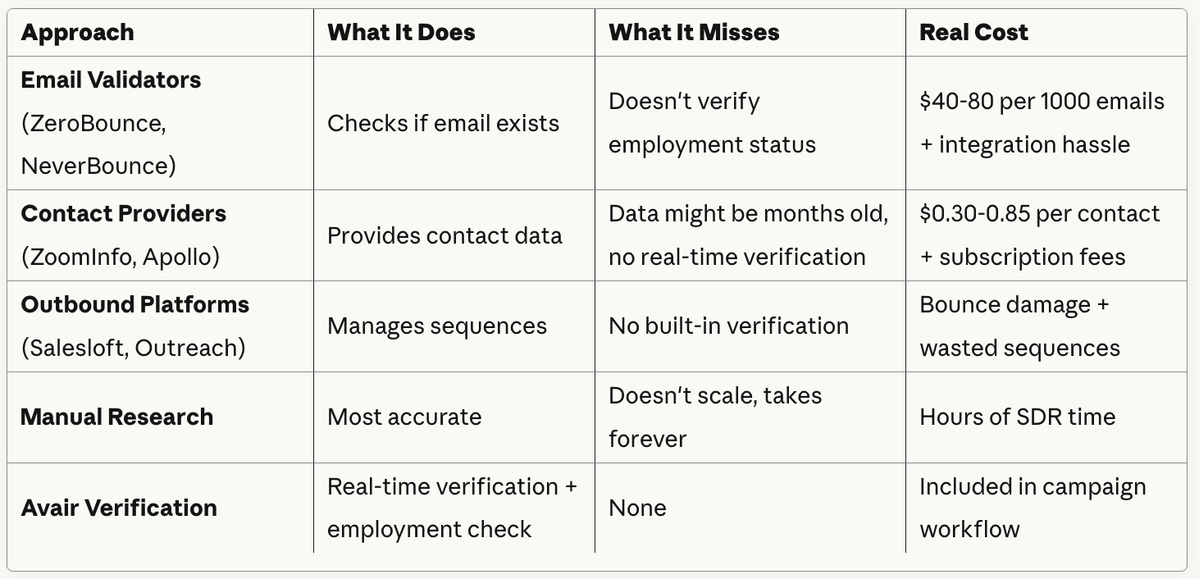
The difference is where the check lives. A separate validator means exporting a list, running it, importing the results and hoping nothing shifted in between. AvairAI verifies inside the campaign itself, at launch, with no CSV round-trip and no manual merging. Clean data stops being a chore you have to remember and becomes part of hitting send. For anyone who needs the budget argument, we lay out the financial return on clean contact data in detail.
Questions we get
Is this just email validation with a new name?
No. Validation checks formatting and whether a domain exists. Contact Verification also confirms the person still works there and that the mailbox will accept delivery. It answers a deeper question, whether the contact is real and reachable, not just whether the address is well formed.
How accurate is it?
In our testing we have seen about 95% accuracy on email deliverability, with employment checks that track closely to how campaigns actually perform. The yellow tier exists for the cases that are not clear-cut, so a human makes the call.
Does it slow campaign creation down?
It saves time on balance. Fifteen minutes up front beats hours spent later untangling bounces, spam complaints and bad records after a campaign is already out the door.
What if I disagree with a rating?
You decide. The colors are recommendations from the analysis. You can keep or cut any contact regardless of how it scored. We supply the evidence, you make the call.
Is my contact data secure?
Yes. Verification runs over encrypted connections, and we do not store or share your list. It is processed, rated and the results come back to you.
The bottom line
You cannot earn a reply from a contact who does not exist, and you cannot protect your sender reputation while a third of your list bounces. Bad data is not a clerical nuisance. It quietly drains pipeline, burns your reps' time and follows your domain from one campaign to the next.
Verifying at the moment of launch closes that gap. You know who you are reaching, your messages reach inboxes instead of spam folders, and your team spends its hours on real conversations rather than chasing people who moved on. That is the point of clean data inside a Pair Selling model: AvairAI handles the grind of checking every contact so your salespeople can do the work only they can, building the relationships and closing the deals. It also keeps the outreach honest, since you are only ever reaching people who are actually there.
See how much of your current list is still reachable by running Contact Verification on your next campaign, or take a closer look at how AvairAI builds and runs the whole campaign. The number of contacts that come back red is usually the surprise.
← Back to all articles