AvairAI's TCPA Compliance Check: Classify Every Phone Number Before You Call
AvairAI's built-in TCPA Compliance Check screens every contact against the DNC registry, line type and opt-outs, then sorts each number into safe, manual-only or do-not-call, so your team knows what is safe to dial before anyone picks up the phone.


Key takeaways
- A TCPA violation carries $500 in statutory damages per call or text, and a court can raise that to $1,500 for a willful violation. There is no cap, so a single campaign adds up fast.
- These are not fringe spammers. In 2025 QuoteWizard settled a TCPA texting case for $19 million, and banks, insurers and retailers with full legal teams have paid similar sums.
- The B2B exemption is narrower than most teams assume. Calling a mobile number with an autodialer or an artificial or prerecorded voice still requires the prospect's prior express consent.
- More than 253 million numbers sit on the National Do Not Call Registry (FTC, FY2024), and courts have treated mixed-use cell numbers on the list as presumptively residential.
- AvairAI's built-in TCPA Compliance Check screens every contact before you call and sorts each number into one of three buckets: safe, manual-only or do-not-call.
The Telephone Consumer Protection Act (TCPA) is the federal law that limits telemarketing calls, autodialers, artificial or prerecorded voice messages and unsolicited texts. If your team picks up the phone to reach prospects, TCPA compliance is not a back-office detail. It is the difference between a clean pipeline and a class-action exhibit.
Consider QuoteWizard. In 2025 the lead-generation company agreed to a $19 million settlement over text messages it sent to numbers on the Do Not Call Registry. QuoteWizard is not a fly-by-night operation. It had lawyers, a compliance function and a brand to protect, and it still wrote the check.
That is the uncomfortable part. Most TCPA defendants are legitimate businesses doing ordinary outreach. The law is strict liability, which means good intentions are not a defense. So before your next campaign goes out, one question is worth answering honestly: if you dialed 100 random numbers from your database today, how many would actually be safe to call?
This article covers what TCPA really reaches, why manual and bolt-on compliance keep leaving teams exposed, and how AvairAI, the AI sales prospecting platform for B2B teams, builds the check directly into the campaign so you can answer that question in one click.
What TCPA actually covers (and the B2B myth)
Most people picture TCPA as the law against car-warranty robocalls. It is far broader, and it reaches plenty of legitimate B2B outreach.
Start with the price of getting it wrong. Each illegal call or text carries $500 in statutory damages, and a court can treble that to $1,500 for a willful or knowing violation (47 U.S.C. § 227). There is no statutory cap. Take a routine 1,000-contact campaign where roughly 100 numbers turn out to be on the registry. Call each of those once and you have created $50,000 to $150,000 in exposure, on a single pass through the list, before anyone replies.
Then there is the B2B exemption, which is real but thin. The Telemarketing Sales Rule exempts most calls that sell to a business, so teams assume they are covered. Two things break that assumption. First, the exemption only applies when you are selling to the business itself, and it covers business landlines, not personal cell phones. Second, and more important, it does nothing for TCPA's consent rules. Calling a mobile number with an autodialer or an artificial or prerecorded voice, AI-generated voices included, still requires the prospect's prior express consent.
Mobile numbers are where this bites. A federal appeals court has held that mixed-use cell numbers listed on the registry are presumptively residential, and the burden is on the caller to prove a number is business-only. Given that more than 253 million numbers are on the registry, a meaningful share of the "safe" B2B mobile numbers in your CRM are not safe at all. Several states run their own state mini-TCPA laws on top of the federal rules, which only widens the gap between what feels exempt and what is.
Why manual and bolt-on compliance leave gaps
The do-it-yourself answer is to scrub against the DNC list, and it is harder than it sounds. Accessing the full national registry runs about $22,000 a year, the data has to be re-pulled at least every 31 days, and the registry is only one input. To actually clear a list you also have to check line type (mobile, landline or VoIP), screen for reassigned numbers where old consent no longer applies, watch for known TCPA litigators, honor your internal do-not-call list, confirm calling windows in each contact's time zone, and make sure your scripts carry the required disclosures.
Bolt-on compliance tools handle parts of this, but they live outside your campaign. You export a list, upload it, wait, download a CSV, interpret it, then manually pull the risky numbers back out of your calling list, every 30 days. Each handoff is a chance to dial a number you meant to exclude, and because TCPA is strict liability, "we missed one in the export" is not a defense. For the full rulebook in plain language, our TCPA compliance guide for sales leaders walks through each requirement.
The result is that most teams land in one of two bad spots. They call recklessly and hope, or they back away from the phone entirely and watch conversion rates fall. Neither is necessary. The phone still works; it just has to be safe to use.
One check, three answers: green, yellow, red
AvairAI builds a compliant calling program into the campaign itself, so compliance is not a separate project.
You set up a campaign the way you normally would, with your messaging, targeting and contact list. Before launch, you open the TCPA Compliance Check inside the campaign. You do not export anything or leave the platform.
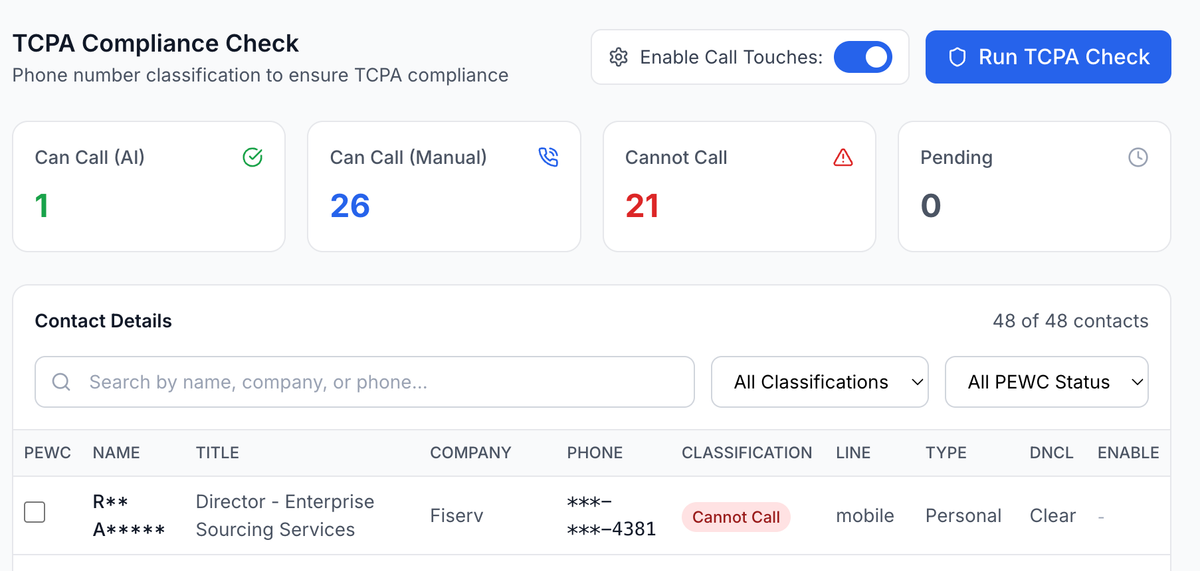
You click Run TCPA Check, and within a few minutes every contact is sorted into one of three buckets:
- Safe (CAN_CALL_AI). The number cleared every screen: it is off the registry and your opt-out list, the line type checks out, and it is not flagged as a litigator.
- Manual only (CAN_CALL_MANUAL). Something needs a human's judgment, a borderline line type or a consent question, so the contact routes to your reps in Manual Tasks rather than any automated call.
- Do not call (CANNOT_CALL). Personal mobile numbers, registry hits, reassigned numbers, known litigators and opt-outs. AvairAI removes these from the calling list automatically. You can still reach them by email or LinkedIn; the phone is simply off the table.
A word on the AI Call Agent: automated calling is a secondary, TCPA-limited capability, used for warm or opted-in contacts, never a way to cold-call at scale. Your reps make the cold calls and LinkedIn touches from ready-to-run tasks, the AI sends the emails, and the compliance check protects every one of those calls. That division of labor is Pair Selling, and it is also what keeps the calling compliant.
A worked example
Say you are launching a calling campaign with 500 contacts, 200 of which have phone numbers. You run the TCPA Compliance Check and it comes back:
- 84 contacts (42%) land in do-not-call
- 72 contacts (36%) are manual-only
- 44 contacts (22%) are cleared
You just kept 84 risky numbers out of your calling list before a single dial. At $500 to $1,500 per violation, that one decision took $42,000 to $126,000 of potential exposure off the table. The 72 manual-only contacts go to your reps in Manual Tasks, where a person can apply judgment. The 44 cleared contacts are ready to go. Same campaign, far less risk, and none of it required a compliance specialist.
Protection that keeps running
A pre-launch check is the baseline, not the whole job, because the data moves. People opt out, numbers get reassigned, and registry status changes. AvairAI re-screens active campaigns weekly, so a number that becomes unsafe mid-campaign drops out on its own.
Two more guardrails run automatically. The platform enforces calling windows, no calls before 8 a.m. or after 9 p.m. in the contact's local time, so no one has to do time-zone math by hand. And it builds the required disclosures into AI Call Agent scripts: identifying the call as AI, naming your company and giving opt-out instructions.
This matters whether or not you ever use the AI Call Agent. If a rep personally dials a number on the registry, the violation is identical to an automated one. The check tells you which numbers are safe to dial, by any method, before anyone picks up the phone, which is why combining AI and human calling only works on top of a clean list.
How the classification works
The check is layered. It starts with your internal opt-out list, because that is instant and absolute: if someone asked not to be called, AvairAI catches it first. Numbers that pass are checked against multiple authoritative data sources, including the federal and state Do Not Call registries, line-type identification, reassignment records and known-litigator lists, and the results merge into a single classification.
The bias is toward caution. When the data is incomplete or two signals conflict, AvairAI defaults a contact to manual-only or do-not-call rather than clearing it. In compliance, a false "safe" is the expensive mistake, so the system is built to avoid it.
Frequently asked questions
Does this guarantee I will never be sued? No tool can promise that. What a documented, pre-call screen does is remove the most common violation triggers before you dial and give you evidence of a good-faith compliance process, which courts weigh in your favor. Think of it the way you think about security: it does not make an incident impossible, but it makes one far less likely and leaves you in a much stronger position if anything happens.
Can I still reach do-not-call contacts? Yes. The classification only governs phone calls. Those contacts stay reachable by email, LinkedIn or any non-phone channel.
I run B2B sales, so am I not mostly exempt? This is the costliest misconception. The B2B exemption is narrow and does not waive TCPA's consent rules for mobile numbers. If a number is on the registry or is a personal cell, you generally need consent regardless of who answers it.
What if I already have consent? You still need the check. Consent does not override DNC registration, and it does not address reassigned numbers, line type, litigator status or calling windows. Consent and DNC screening are two separate layers, and you need both.
The bottom line
TCPA compliance has a reputation for requiring a lawyer, a budget and a dedicated team. It does not. It requires the check to be built into the system instead of bolted on afterward, so it runs every time without anyone remembering to run it.
The phone is still one of the most direct ways to build a relationship and move a deal. The teams that win with it are not the ones avoiding it out of fear or using it recklessly; they are the ones who know, before they dial, which numbers are safe. AvairAI gives your team that answer in one click and keeps checking while the campaign runs, so your reps can spend their hours selling instead of second-guessing the list.
Want to see how your own contacts sort out? Start a 14-day free trial, no credit card required, and run a TCPA Compliance Check on your next campaign.
← Back to all articles